

Kim secures $1.88M to mimic red blood cells
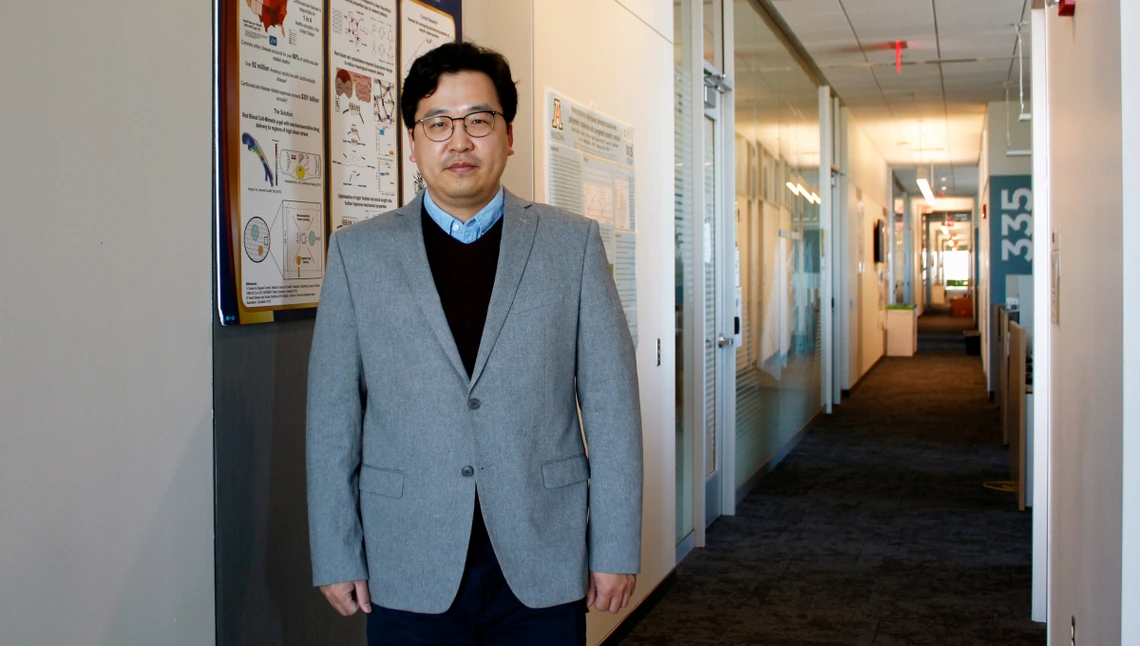
Minkyu Kim, associate professor of materials science and engineering and biomedical engineering, leads the Kim Research Group in developing super-small drug carriers.
Associate professor of MSE Minkyu Kim has won a five-year, $1.88 million Maximizing Investigators’ Research Award from the National Institute of General Medical Sciences to develop a long-lasting drug carrier disguised as red blood cells.
Drug carriers shield medicines as they travel through the bloodstream, releasing medicine at targeted spots in the body while sparing healthy tissue along the way.
However, Kim said, "Our immune system and filtering organs such as the liver, spleen and kidneys are very effective at removing foreign materials from the bloodstream."
"Many drug carriers are cleared too quickly, and higher doses are often needed to compensate, which increases side effects and reduces the effectiveness of treatment."
Over the past 50 years, drug carriers have evolved from polymer-coated capsules that resist stomach acid to microcarriers delivered intravenously. Their small size allows them to access more areas of the body.
“At the same time, many blood-circulating carriers still face a common obstacle – the body’s defense and filtration systems can remove them before enough medicine reaches the target site,” Kim said.
Red blood cells can circulate the body for about 120 days, squeezing through tiny blood vessels and repeatedly returning to their original shape.
"I started asking why red blood cells can travel anywhere in the circulatory system while many engineered particles are removed so quickly," Kim said.
He found that imitating a red blood cell’s cytoskeleton – a network of proteins that give cells their flexibility and durability – in synthetic microcarriers could be his solution.
“Researchers have made important progress in mimicking different features of red blood cells,” Kim said. “My group is focusing on the internal protein network that helps red blood cells flex, recover and survive in circulation for long periods of time.”